Energy Efficiency & Cost Savings HVAC Technology & Innovations
Bigger is better. Less is more. When it comes to choosing the right size for an HVAC system, which is it? You might be surprised at the importance of properly sizing a new residential HVAC system. If the cooling or heating system is oversized or undersized, it will waste energy and underperform. If you’re ready to update your existing heat pump, air conditioner, or whole-home heating and cooling system, the size you choose is critical.
Here, we’ll take a look at why the size of your HVAC units is so important, how to calculate the right size for your home and location, and get a better understanding of the potential fallout of choosing a system that’s too big or too small for your needs.
It absolutely does. When it comes to HVAC systems, size isn’t just important. It’s critical to your comfort… and your bank account.
Proper HVAC sizing ensures your system operates at peak efficiency. An oversized unit won’t heat or cool more effectively. In fact, it will usually cycle on and off too frequently (called short cycling), wasting energy and wearing out your equipment. Meanwhile, an undersized system will run constantly as it struggles to maintain comfortable temperatures, all while driving up your energy bills.
The right-sized HVAC system maintains consistent temperatures, operates efficiently, and maximizes its lifespan. Professional load calculations, rather than guesswork or rules of thumb, are the key to getting it right the first time.
The first step in understanding the importance of HVAC sizing is calculating cooling and heating loads specific to the home. There are three main types of loads.
This cooling or heating load is directly connected to designated design conditions in your home – in other words, pre-determined summer and winter temperatures considered typical for the sort of load your HVAC system will have to deal with during cold or hot weather. For a certain area and climate, the design temperature might be 84 degrees in the summer and 18 degrees in the winter. Various factors, including your home’s size, layout, and energy efficiency, will be considered in determining how much cooling or heating will be needed to bring your home to a designated comfortable temperature during outside design conditions.
Extreme loads occur during the coldest or hottest days of the year. A skilled HVAC installation technician would never recommend a heating or cooling system based on an extreme load. This would render the system oversized for all other times, resulting in the many negative consequences of an oversized HVAC system.
In any home, the partial load is the most common requirement for your cooling or heating system. Even during a cold or hot day, most of the time the temperature is either building up to a peak, or descending/digressing back from that highest or lowest temperature. Similarly, during milder weather, or in the spring or fall, design temperatures will seldom be reached. This means that a standard HVAC system will have too much capacity during the greater part of a day or a year. In recent years, fortunately, HVAC technology has seen advancements in variable-speed and multi-level functioning, meaning systems can adapt their running level to current conditions.
So, once you know your home’s heating and cooling load, what can you do with that information? Determining the right HVAC system size requires accurate calculations that account for your home’s load and other unique characteristics. Here are the three main methods HVAC professionals use:
Manual J is the gold standard for HVAC sizing, and is the method recommended by most HVAC technicians. This comprehensive calculation considers dozens of factors including your home’s square footage, insulation levels, window sizes and placement, ceiling heights, local climate, number of people in residence, and even which direction your home faces. A qualified HVAC contractor will perform this detailed assessment to determine your home’s exact heating and cooling load. While it takes more time than simpler methods, Manual J provides the most accurate results and helps ensure you’re not over- or undersizing your system.
This method offers a quick estimate based on the total square footage of your home. As a general rule, you’ll need approximately 20-25 BTUs (British Thermal Units) per square foot of living space. For example, a 2,000 square foot home would require roughly 40,000-50,000 BTUs of cooling capacity. While this method is faster and easier than Manual J, it’s less precise because it doesn’t account for variables like insulation quality, window efficiency, or ceiling height.
HVAC tonnage refers to cooling capacity, with one ton equaling 12,000 BTUs per hour. The typical calculation suggests one ton of cooling for every 400-600 square feet, meaning a 2,000 square foot home would need a 3.5 to 5 ton system. However, this range is quite broad because tonnage requirements vary significantly based on climate zone, home construction, and other factors. In hot, humid climates, you’ll likely need capacity on the higher end of the range, while moderate climates may require less. Like square footage calculations, tonnage estimates should be verified with a more detailed assessment.
| Square Footage | BTUs Needed (20 BTU/sq ft) | BTUs Needed (25 BTU/sq ft) | Tonnage Range* |
| 500 sq ft | 10,000 BTU | 12,500 BTU | 1 ton |
| 750 sq ft | 15,000 BTU | 18,750 BTU | 1.5 tons |
| 1,000 sq ft | 20,000 BTU | 25,000 BTU | 1.5 – 2 tons |
| 1,250 sq ft | 25,000 BTU | 31,250 BTU | 2 – 2.5 tons |
| 1,500 sq ft | 30,000 BTU | 37,500 BTU | 2.5 – 3 tons |
| 1,750 sq ft | 35,000 BTU | 43,750 BTU | 3 – 3.5 tons |
| 2,000 sq ft | 40,000 BTU | 50,000 BTU | 3.5 – 4 tons |
| 2,500 sq ft | 50,000 BTU | 62,500 BTU | 4 – 5 tons |
| 3,000 sq ft | 60,000 BTU | 75,000 BTU | 5 – 6 tons |
| 3,500 sq ft | 70,000 BTU | 87,500 BTU | 6 – 7 tons |
| 4,000 sq ft | 80,000 BTU | 100,000 BTU | 6.5 – 8 tons |
Square footage and home characteristics aren’t the only factors in determining HVAC sizing. Where your home is located is just as important to choosing the right size. That’s because a home in a warmer climate will need an HVAC system with more cooling capabilities, while a home in a colder climate will put a heavier load on the furnace. Homes in temperate areas will need to strike a balance between the two, often meaning the best option is a heat pump, which takes care of both heating and colling the home.
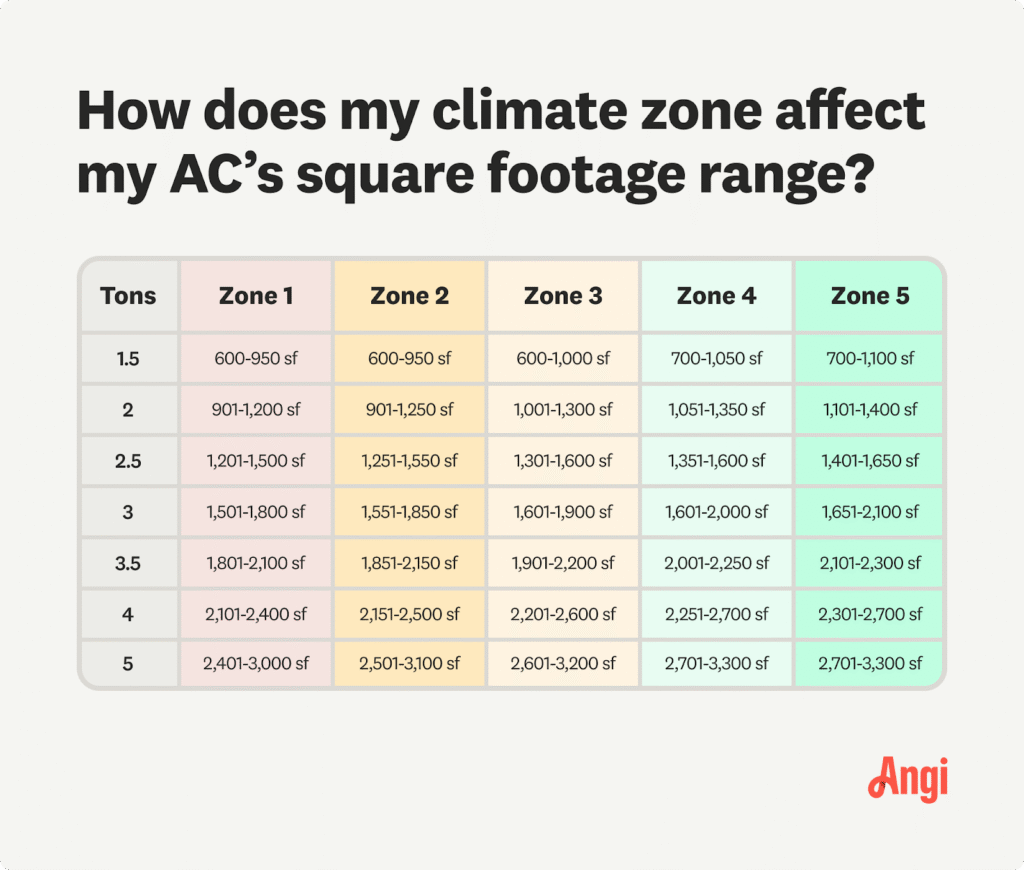
You can check your climate zone online, and use that information combined with your home’s square footage to get a rough idea of the cooling and heating capacity you will need from your furnace or AC unit.
Every home needs to find the perfect fit when it comes to HVAC equipment, but what exactly can happen if you choose the wrong size?
It is possible to experience year-round comfort no matter where you live or what size house you have. Homeowners should consider these factors and more when replacing their existing HVAC system or when purchasing a new home. Furnace and air conditioner size matter more than you think, so getting it right is key to your ongoing home comfort (and lower energy bills). If pricing is your concern, Airtron is here to help. Our HVAC experts can perform Manual J calculations and other estimates to determine the perfect fit for your home. And our online estimator can give you a free quote in minutes, so you can be on your way to a more comfortable and energy efficient experience.